Leave Jinsha off this plan. Its closure notice covers the entire site through 30 April 2027; wait for an actual reopening notice before treating it as a visitable alternative.
02
NIGHTS AND NAMED COMBINATIONS
How long, and what goes together
Start with three nights for two protected full days when travel uses the arrival and departure dates. A fourth night is useful only if it creates a third full day for another city theme or one nearby trip. Two nights can work when an early arrival and late departure genuinely leave two usable days; count those hours before paying for sights. These time budgets assume an ordinary walking pace and have no field timing. Add your hotel journey at each end and follow the actual ticket and opening calendar.
#01 Panda Base → #03 tea or #08 dinner
Central hotel → Panda Base → lunch and rest → People’s Park or Chunxi Road. Allow 3–4 hours in the Base plus about 2–3 hours across both public-transport legs. That is already a 5–7 hour outing before a long lunch. The afternoon works only because tea or dinner can be shortened; move it to the next day if queues or heat take the energy out of the morning.
Book the morning period before fixing the day’s other plans. Save Sanxingdui for another day: both are substantial visits outside the central sightseeing areas.
#02 Chengdu Museum → #03 People’s Park
Tianfu Square → Chengdu Museum → lunch → People’s Park / Heming. Plan 2–3 hours in the museum, an hour for lunch, 1–2 hours for tea and about an hour across local walking, waiting and rest. A 5–7 hour central day works because the two stops lie west of the centre; #07 Kuanzhai adds another 1–1½ hours and is the first part to delete.
Get the museum reservation for an open day first. If museums are a poor fit, use #06 Wenshu and its streets for the morning instead; the transfer is longer, so drop Kuanzhai.
One more cultural block: #04 or #05
#04 Wuhou Shrine → Jinli → dinner suits Three Kingdoms interest: allow 1½–2½ hours in the shrine and up to 1½ hours in Jinli. Start the ticketed visit well before last entry, then use the street afterward.
#05 Du Fu Thatched Cottage → Huanhuaxi → an early dinner suits poetry and gardens: allow 2–3 hours in the museum and about an hour in the park. A wet afternoon can be spent mainly in covered spaces, but the garden is still outdoors. With only half a day, choose one cultural anchor.
Nights and actual full days in Chengdu
Stay if travel uses the edge days
A balanced use of protected days
What to leave out
1–2 nights · 1 full day
Pandas if that is your reason for coming; otherwise history-and-tea or Wuhou and a meal.
The surrounding region. Keep a day trip away from an airport departure.
3 nights · 2 full days
One panda day and one central day. If you skip pandas, choose two different city themes.
Most nearby trips; you are choosing a first taste, covering selected themes.
4 nights · 3 full days
The two-day plan plus one day trip, or another cultural city day with Wenshu and more meals.
A second far-reaching outing unless you deliberately give up a city day.
5–6 nights · 4–5 full days
Add a second nearby destination or slow down for both poetry and Three Kingdoms, tea and food.
Keep Emei or Jiuzhaigou as a distinct onward stay rather than calling either a casual extra.
03
DATE, DOCUMENT, FALLBACK
Book the visits that can break your Chengdu days
Panda Base first if it is a reason for coming. Choose the actual morning or afternoon and the gate that fits your return before paying. The Base sells dated, real-name admission up to 14 days ahead through its listed channels; take the passport used in the order. Panda Valley and the internal sightseeing bus are separate purchases. When South versus West Gate changes your walking range and journey back, settle both the entrance and exit before purchase.
Reserve Chengdu Museum for an open day. Standard entry uses a free real-name reservation; a special exhibition can be a different ticket. Start from the museum visitor page and follow the currently offered channel. Passport visitors should use its ticket-information window for exchange and keep the exact booking document; read the dated calendar for any Monday or holiday exception. Admission distinction.
Put the chosen paid cultural sight on that day. Wuhou Shrine’s current official page gives CNY 50 adult admission, passport booking and a 17:00 normal last entry. Du Fu’s normal ticket page gives CNY 50 and a 17:00 ticket-sales end; its earlier passport-window notice should be reviewed before relying on that counter on a holiday. Choose one if time is short.
Lock a third-day outing only after the return is real. Sanxingdui’s separate inbound-passport instructions last reviewed on 20 September used an operator form and written approval before ticket exchange; get the museum’s current channel and an actual two-way bus or train plan before fixing the outing. Leshan’s land and boat products can change independently; the current boat point, price and passport flow still need an operator answer. For Dujiangyan or Qingcheng, buy the chosen scenic product and read both directions between Xipu and the issued rail station. If the ticket or return remains unresolved, keep a Chengdu city day rather than setting off on an assumption.
Keep the issued booking, matching passport, hotel’s Chinese address and actual rail or airport name offline. A sent form or unissued museum booking cannot open a gate.
04
A BASE FOR YOUR WHOLE VISIT
Where to stay in Chengdu: choose for the evenings as well as the panda morning
Default to the Chunxi Road / 春熙路 area for a first mixed stay: dinner and an arrival-evening walk are nearby, Line 2 connects with Chengdu East and Line 3 starts the Panda Base journey. Its cost is a busy commercial setting and a real street walk from the Metro to your actual hotel; neither airport is a one-seat ride here. Choose Tianfu Square for a museum-first stay or Wenshu/Gulou for a quieter-looking base only when the extra station changes suit your day plan.
Default example: Chunxi Road
Grand Hyatt Chengdu / 成都群光君悦酒店, 春熙南路8号, is a full-service option on the Chunxi commercial side. From Chunxi Road / 春熙路 station, use the current street map for that exact address and the signed hotel entrance, then walk the final block; allow about 10–15 minutes for the station-to-lobby leg in your plan, an editorial walking allowance without accessibility testing. The hotel’s own page gives the name, address and 028-66661234. Obtain a date-specific room total, occupancy and passport check-in answer before choosing it.
Conditional alternative: Wenshu and Gulou
Holiday Inn Express Chengdu Gulou / 成都鼓楼智选假日酒店, 大墙西街72号, is the limited-service comparison. The operator names Taisheng South Road / 太升南路 on Line 4 as its Metro stop; use the actual exit-to-大墙西街72号 walking route and allow about 10–15 minutes as a planning buffer, then use a legal car if that last leg is too difficult with your party’s luggage or mobility needs. Its current room page lists triple and connecting-room options. The hotel states it has no airport shuttle. Official address and transport · room options.
Where to stay in Chengdu
Area
Choose it for
The tradeoff
Chunxi Road / Taikoo Li / IFS
The default mixed stay and Grand Hyatt example above: dinner nearby, Lines 2 and 3 useful for rail and pandas.
Commercial bustle, a street walk to the hotel, and an airport transfer.
Tianfu Square / People’s Park
Museum-and-tea days and central connections. Tianfu Square has Lines 1 and 2.
Pick the exact block and hotel entrance. Chunxi departure points may still require a transfer.
Wenshu / Gulou
The named Holiday Inn Express example above and more time around the monastery.
You may add a Metro change for pandas or the rail station. The old-city label still requires a room-specific quietness request.
Wuhou Shrine / Jinli
Three Kingdoms interest and western/southwestern visits, especially with a CTU arrival on Line 10.
Less convenient for repeated trips northeast to the Panda Base or to the IFS bus pickup.
Airport or station
A genuinely early departure or a very late, short stop.
Saving one transfer can cost every city evening. Match the exact terminal or station and ask the hotel about its shuttle, if offered.
These are area and format comparisons without a tested stay or price ranking. Obtain a date-specific total including breakfast, cancellation and any deposit, and send the exact passport, occupancy and late-arrival needs with the booking. For mobility needs, request the actual room and bathroom configuration rather than relying on a general accessibility icon. Save the Chinese address in the hotel-address card.
05
TFU, CTU AND YOUR ACTUAL STATION
Getting to Chengdu: reach your hotel from the airport or station
Tianfu (TFU) and Shuangliu (CTU) are different airports; Chengdu East, South and West are different railway stations. Read the issued ticket before using a route below. These routes lead to the Chunxi Road base; other hotels need their own final leg. Time ranges are editorial allowances from the public arrival area to a central hotel, including transfer waits and the final street leg; add a disruption margin.
Arrival choices to a Chunxi Road hotel
Name on your ticket
Route toward Chunxi Road
Last connection and failure choice
Chengdu East · 成都东
Follow Metro signs to Line 2 and ride to Chunxi Road / 春熙路.
Use the Chinese hotel address for the correct exit and final walk. Allow roughly 45–75 minutes station-to-lobby; use the staffed taxi rank if luggage or the last leg makes Metro impractical.
Chengdu South · 成都南
Line 1 toward Tianfu Square, then Line 2 to Chunxi Road; use the station's signed Metro connection.
At Chunxi Road, navigate to the hotel entrance by address. Establish that both trains still run at your arrival time; otherwise take an official taxi from the station.
Chengdu West · 成都西 or Xipu · 犀浦
Chengdu East is a separate station. Enter the exact issued station in the current Metro planner and select a route to Chunxi Road before travelling.
Save the live transfers and final exit, or use the station's staffed taxi rank. A train to Xipu for a day trip departs from the station printed on the ticket.
Shuangliu · CTU / 双流
Line 10 toward Wuhou Shrine; change at Gaoshengqiao / 高升桥 to Line 3 for Chunxi Road. T1 Metro access is outside arrivals Exit 04; T2 access is on B2.
Allow roughly 60–90 minutes to a central hotel. Read the complete transfer chain late at night; if it has ended, use the official taxi rank and show the Chinese address.
Tianfu · TFU / 天府
Line 18 from the T1/T2 transport centre to South Railway Station, then Line 1 to Tianfu Square and Line 2 to Chunxi Road. Choose the actual Line 18 service shown on the board.
Allow roughly 90–150 minutes by Metro, or 1½–2 hours as a car-planning buffer. If the full Metro chain has ended, take a current airport bus that reaches your stop or use the signed taxi rank.
Finish the route at the booked hotel. For Grand Hyatt Chengdu, leave Chunxi Road station using a current map for 春熙南路8号 and its signed entrance; reserve 10–15 minutes for this untested station-to-lobby leg. For Holiday Inn Express Chengdu Gulou, plan to 太升南路 on Line 4 and then 大墙西街72号, with the same planning allowance. Use the hotel’s mapped entrance rather than the broad “central” label; a taxi can finish either route if the walk fails. Grand Hyatt address · Gulou hotel address and Metro stop.
Fare comparison: Metro is the default for predictable routing and modest cost; use the official journey planner or ticket machine for the full route’s fare. Airport buses charge for the selected route, and taxis charge per vehicle. A current complete fare table remains unavailable for this revision, so no invented hotel-to-airport prices are supplied. If comparing a prebooked car, obtain a total including tolls, waiting and the passenger/luggage count.
CTU’s listed last Line 10 departures toward the city are 23:15 from T1 and 23:12 from T2, reviewed 26 September. These are airport departures, only the first leg; Line 3 needs its own live service. Ask staff about the complete chain if you are close to the end of service. The older CTU Night Bus 1-to-Chunxi times were absent from the current page; use the airport’s live display for the bus to your stop. If no suitable bus remains, use the official taxi rank. CTU Metro · airport buses · taxi information.
A former TFU ground-transport page failed to reload on 26 September, so no old bus timetable or pickup bay is treated as current. Follow the terminal’s signed airport-bus or taxi area and read the selected bus’s actual stop and last onward connection before boarding. A bus running late somewhere in the network may still miss your hotel connection. Tianfu ground-transport reference.
Return to the departure point printed on your ticket. From the default Grand Hyatt base, walk back to Chunxi Road station and reverse the appropriate complete route above; use the hotel address as the taxi origin if taking a car. Find the final transfer and terminal or train-station entrance on the actual day, work backward from airline or railway check-in, and add a disruption margin. If the last Metro chain ends before you can finish it, use a legal car from the hotel rather than gambling on one train that only reaches a transfer. Avoid a distant scenic return immediately before a flight. For the wider route, use the train-planning guides with the stations printed on your tickets.
06
CITY LEGS AND THE WAY BACK
Getting around Chengdu: move by area and return to your hotel
Use the Metro for a longer cross-city leg and walk within a chosen area. Before leaving the hotel, search the Chinese destination and its entrance, then review the station, direction, transfer and final street walk. From 熊猫大道, take public bus 408 onward to Panda Base South Gate and plan the return from your chosen exit. For a museum-and-tea day, use Tianfu Square’s west exits for Chengdu Museum, then walk toward People’s Park only if that distance fits your group. Panda gate approaches · museum address and exits.
At a Metro station, use the current official station map or ask staff for the right exit and a usable ticket/payment option before passing the gate. If a phone code or payment method fails, go to a ticket machine or service point rather than repeatedly tapping an unissued code; use a machine or service point if a foreign bank card fails. Keep the ticket or active trip until you leave the destination station. The rail operator’s station guidance is an orientation aid, not a current fare or last-train table.
Use a staffed taxi rank or a licensed app pickup when luggage, rain or a late arrival makes the last walking leg unreasonable. Show the exact Chinese hotel address and entrance, rather than only “Chunxi Road” or “Chengdu East”. For a day trip, save the outbound and return station separately and work back from the last useful connection to that hotel; an attraction closing time cannot substitute for the train home.
07
THE CITY AND ITS OUTINGS
Chengdu sights in detail: keep the centre together
Chengdu’s central sights are best understood as several small visits rather than one continuous sightseeing walk. Tianfu Square and People’s Park give you a museum-and-tea day. Wuhou Shrine and Jinli belong together southwest of the centre. Du Fu’s garden and Huanhuaxi make a separate western outing. Chunxi Road and Taikoo Li work well for dinner and an evening stroll.
Relative areas only: not to scale, a transit map or a promise of a step-free walking connection. Use the Chinese place names below in your map app for the actual entrance.
Choose depth before distance. If you like history, Chengdu Museum explains the city, Wuhou Shrine focuses on the Three Kingdoms, and Du Fu Thatched Cottage combines poetry with a garden. They are different visits; choose the ones that match your interests. If eating and city life are your priority, leave room for Wenshu, tea and several meals rather than adding another museum.
Jinsha is currently closed. The museum’s notice closes all areas from 5 December 2025 through 30 April 2027. Choose Chengdu Museum for a city introduction or Sanxingdui for a dedicated ancient-Shu outing; neither is presented as the same collection.
08
CHENGDU RESEARCH BASE OF GIANT PANDA BREEDING · 成都大熊猫繁育研究基地
Give the pandas a morning of their own
1. Panda Base · 成都大熊猫繁育研究基地
Hours
March–October entry begins 07:30 and ends 17:00; November–February begins 08:00 and ends 16:30. Use the dated period on your operator ticket.
Tickets
CNY 55 adult entry; the CNY 30 internal bus is a separate purchase. Reserve a real-name date and period up to 14 days ahead and carry the booked passport.
Time
3–4 hours inside; allow 60–90 minutes in each direction from Chunxi Road as a planning range.
Metro Line 3 to 熊猫大道, Exit A, then public bus 408 to 南大门; return by 408 to the Metro. West Gate instead uses 军区总医院 Exit B and 409. Gate routes.
How to visit
Choose South Gate in and out for a shorter morning; view the southern areas at an unhurried pace, then leave time for the bus and hotel return. A cross-campus visit needs its own exit plan.
This is a large breeding and conservation campus, a broad campus beyond the Metro exit. The pleasure is in watching behaviour: a panda working through bamboo, shifting between a climbing structure and the ground, or sleeping in a position that seems unlikely to be comfortable. Allow yourself time to stay at one viewing area. Chasing a famous animal across the whole site can consume the morning without improving the visit.
Use 3–4 hours inside as a planning allowance, then keep lunch and the afternoon flexible. A morning booking makes an early start possible; it leaves feeding, outdoor viewing, cubs and each animal’s location uncertain. Read the site’s current visitor map and the day’s display notices when choosing your route.
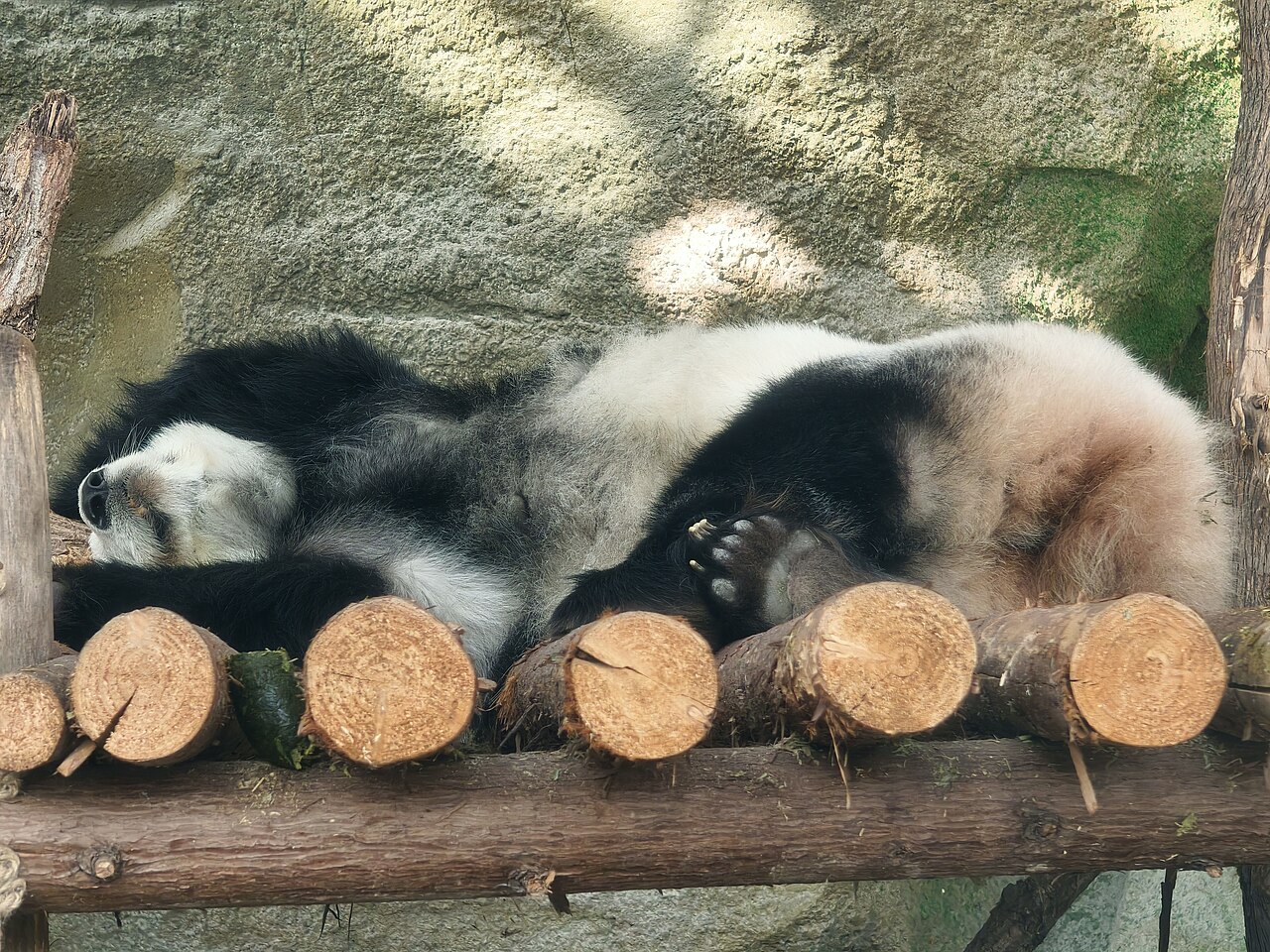
A visit is time spent observing living animals, including quiet moments such as this rest at Chengdu Panda Base.Photo: MspreilsCN, November 2025 · CC BY 4.0. Scaled by Wikimedia Commons.
Choose your entrance and how far you want to go
Two useful ways into the Panda Base
Entrance
From central Chengdu
A sensible visit
South Gate · 南大门
Metro Line 3 to Panda Avenue / 熊猫大道, Exit A, then bus 408 to the gate.
Use the southern visitor areas as your focus. This suits a shorter visit that finishes at the same gate; the Metro station itself still needs the onward bus.
West Gate · 西大门
Metro Line 3 to Military General Hospital / 军区总医院, Exit B, then bus 409 to the gate.
Start with the western areas or use the internal sightseeing bus toward the south. An end-to-end visit needs a return from the other gate.
Default to South Gate in and out when pandas are one protected morning within a two-day city stay. Consider West Gate only for a longer campus walk and decide the exit before boarding an internal bus: a West-to-South route changes the public return leg. The official in-park bus reduces distance between zones but adds fare and possible reboarding queues; it leaves wheelchair suitability unresolved. The gate-by-gate itinerary belongs in the linked Panda Base guide above.
Tickets and hours, reviewed 26 September: standard adult admission is CNY 55, with dated morning or afternoon booking up to 14 days ahead. March–October morning entry starts at 07:30; November–February at 08:00. Afternoon entry ends at 17:00 and 16:30 respectively; clearing begins an hour later. Bring the passport used for the booking. The CNY 30 sightseeing-bus ticket is separate, as are the public buses outside the gates. Official ticket rules.
Book through the Base’s WeChat account or an authorised platform listed on that page, including Trip.com/Ctrip. The ticket covers this Base, while Panda Valley in Dujiangyan needs its own ticket. Choose Panda Valley only as a separate outing with its own admission and transport. If online payment fails, the Base describes a staffed-window option when stock remains; that still requires an issued ticket before travel on a busy day.
From Chunxi Road, reserve about 60–90 minutes each way by Metro and public gate bus in your day plan, including hotel access and waiting; this is an editorial allowance, an editorial journey allowance. From South Gate, bus 408 returns to Panda Avenue Metro; from West Gate, bus 409 returns to Military General Hospital Metro. The Base’s Chunxi taxi reference is about CNY 40 and 25–35 minutes before traffic or queues change it. Tell the driver the gate, using the specific gate name. Follow dated crowd-control notices; the National Day West Gate recommendation is a holiday instruction, a holiday-only instruction. Gate-by-gate transport · holiday notice.
Afterward, choose tea, lunch and a rest, or a short Chunxi Road evening. The Botanical Garden is an optional specialist-interest stop north of the city, a specialist-interest extra.
09
CITY LIFE AND CULTURE
Spend time in the places between the big excursions
2. Chengdu Museum · 成都博物馆
Hours
Normally Tue–Thu and Sun 09:00–17:00, last entry 16:30; Fri–Sat 09:00–20:30, last entry 20:00; Monday closed except statutory holidays. Dated exceptions appear on the visitor page.
Tickets
Standard entry is free by real-name reservation; special exhibitions may have separate tickets. Passport visitors use the ticket-information window for exchange. Admission distinction · document process.
Time
2–3 hours for city-history and puppetry galleries.
Metro Lines 1 or 2 to 天府广场, then the museum’s 西1(北) or 西1(南) exit and its signed entrance; People’s Park lies to the west. Operator exits.
How to visit
Secure the actual open date, carry the passport in the reservation, visit the history and puppetry threads, then take lunch before walking west for tea.
Start here if you want to place the city in a longer story before visiting a shrine or an archaeological site. The permanent displays span Chengdu’s history and urban life; the shadow-puppet and puppetry galleries offer another way into Chinese performance, through figures and the craft of making a story visible. Choose the history galleries plus that performance thread instead of trying to read every case. Allow 2–3 hours. Permanent exhibitions.
The museum is on the west side of Tianfu Square at 青羊区小河街1号. Take Lines 1 or 2 to Tianfu Square; the museum’s guide lists the west exits. Use the reservation link on the official visitor page. The museum’s document guidance says passport holders exchange their booking at the ticket-information window and describes email reservation for visitors without WeChat or a domestic number. For that email channel, use the specific passport notice or visitor services at 028-68277011. Keep your passport and booking confirmation together.
The normal calendar is Tuesday–Thursday and Sunday 09:00–17:00 (last entry 16:30), Friday–Saturday 09:00–20:30 (last entry 20:00), with Monday closure except statutory holidays. Dated holiday notices can change it. Arrange it on an open day and attach People’s Park afterward. This makes a substantial city day even if you never leave the centre. Rain does not remove the reservation requirement.
3. People’s Park and Heming Teahouse · 人民公园 / 鹤鸣茶社
Hours
Outdoor park walk in daytime; Heming’s seating and service hours follow its counter on your visit date.
Tickets
Tea is ordered from the menu. The cited park page has no current admission price or Heming menu.
Metro Line 2 to 人民公园, Exit A, then walk to the 祠堂街 park gate; from Chengdu Museum, walk west if it fits your group. Follow park signs for 鹤鸣茶社. Park approach.
How to visit
Ask for the tea menu and an available seat together; decide the per-person or per-bowl charge before ordering. If seating is full, walk the park and move tea to another stop.
The point of this stop is to sit down. Bamboo chairs, small tables and covered porcelain bowls give the teahouse a different rhythm from a café visit or a shopping street. Leave an hour or two for tea and conversation, with a short park walk around it. Heming is a well-known public teahouse, so expect visitors alongside everyday social life rather than a secluded discovery. GoChengdu’s teahouse introduction.
Use the Chinese destination 人民公园内鹤鸣茶社; the park is near People’s Park station on Line 2. From Chengdu Museum, walk west toward the park if the weather and your walking range suit, or take Line 2 one stop from Tianfu Square. Once inside, use the park’s signs for Heming rather than choosing a business elsewhere with a similar English name.
Ask the attendant for a seat and the tea menu together. Jasmine tea, 茉莉花茶, is a useful first tea to ask about; order the listed tea you want, and establish whether the price is per person or per bowl and whether hot-water refills are included. A gaiwan’s lid helps hold the leaves back as you sip. Handle the hot bowl with its saucer and give it time to cool. Ear cleaning, performances and snacks are separate decisions, not assumed inclusions in a tea order.
Show the attendant: 我们有[两]个人,想坐下来喝茶。请给我们看茶单。这个价格是每人还是每杯?续水包括吗? There are [two] of us and we would like tea. Please show us the menu. Is that price per person or per cup, and are refills included?
A current operator menu and seating policy were not available for this revision, so use the menu and available seat shown on arrival. This is a flexible stop: if the wait is too long, enjoy the park and move tea to another part of the day rather than queueing through the afternoon.
4. Wuhou Shrine and Jinli · 武侯祠 / 锦里
Hours
The ticket page gives 09:00–18:00 and last entry 17:00; its homepage currently shows a different opening time. Use the dated order and any venue notice.
Tickets
CNY 50 adult for the heritage area, with 14-day real-name sales. Carry the booked passport and QR code; Jinli purchases are separate.
Time
1½–2½ hours in the shrine; add 45–90 minutes for Jinli if wanted.
Route to 武侯祠博物馆, enter the paid heritage area at its signed gate, then leave toward adjacent 锦里. From the Chunxi Road base, use a live Metro or licensed-car route to the museum gate.
How to visit
Follow Liu Bei and Zhuge Liang’s halls before the garden and tomb area; use Jinli for a meal or stroll after the ticketed visit.
Wuhou Shrine is for the people and memory of the Three Kingdoms: Liu Bei, Zhuge Liang and the Shu state. The halls, inscriptions and commemorative spaces make more sense if you know those names before entering. Spend time following how rulers and ministers are represented, then let the garden walls and planted paths provide a pause. A photo beside a red wall is one small part of a visit whose main subject is history and its later retelling.
Allow 1½–2½ hours for the paid heritage area. The current Chinese ticket page lists CNY 50, 09:00–18:00 and last entry at 17:00, with 14-day advance sales and passport booking. Use that page’s current timetable when the older English page differs. Foreign student discounts have specific document conditions; a student card alone may fail the document rule. Wuhou tickets and hours · passport/cash-window information.
Jinli beside it serves a different purpose: lanterns, snack stalls, crafts and shopping in a recreated traditional-style street. Add 45–90 minutes if that sounds enjoyable, especially after the shrine visit. It is commercial and often busy. Choose a snack because you want to taste it; neither the street’s appearance nor a queue certifies quality. You can omit Jinli without losing the shrine’s history. The provincial tourism authority introduces the Three Kingdoms and performance context.
5. Du Fu Thatched Cottage and Huanhuaxi · 杜甫草堂 / 浣花溪
Metro Line 4 to 草堂北路, then navigate to the actual museum entrance at 青华路37号; leave via the signed exit for a separate Huanhuaxi Park walk.
How to visit
Read one translated poem, visit the literary rooms and reconstructed cottage, then spend the remaining time in the garden. Add Huanhuaxi only if daylight and energy remain.
Du Fu’s Chengdu years give this visit its meaning. The museum and garden commemorate the Tang poet through literary displays, pavilions, shaded paths and a reconstructed cottage setting. Read a translation of a poem before you go, then use the place to think about the contrast between a modest home and the troubled world he wrote about. This is a layered memorial landscape, a reconstruction rather than an untouched Tang cottage.
Give the garden and literary rooms 2–3 hours; in good weather, add a short Huanhuaxi Park walk instead of immediately moving to another ticketed sight. The nearby Sichuan Museum is an alternative for a more object-focused afternoon, especially if its advertised collection or temporary exhibition matches your interests. Read that museum’s own booking and exhibition notices; it is a separate institution from Chengdu Museum.
For the cottage, use 青华路37号. Line 4 at Caotang North Road gets you into the area; continue to the museum entrance on your map. Normal admission is CNY 50; the official ticket page lists 09:00–18:00, with sales ending 17:00. Its 25 September–7 October 2026 notice extends opening to 08:30–18:30 and sales to 17:30. The earlier passport notice describes purchase at the comprehensive service window. Normal ticket page · passport purchase · garden and exhibitions.
6. Wenshu Monastery · 文殊院
Hours
Visit in daytime; the association page has no current public gate timetable. Follow the posted gate notice.
Tickets
The cited association page gives no current admission product or event charge; ask at the temple gate if attending a special activity.
Time
1½–2½ hours with a meal or walk through the surrounding streets.
Metro Line 1 to 文殊院; follow the map to the temple’s 山门 on 文殊院街 rather than stopping at the shops of 文殊坊.
How to visit
Enter through the 山门, pass the 天王殿 and main halls respectfully, then return to the street for lunch. The Buddhist association describes the hall sequence.
Wenshu provides a living Buddhist setting with a different purpose from a historical museum. Enter the courtyards slowly, notice the sequence of halls and the people using them for worship, and keep cameras away from services or places where photography is restricted. The present complex’s Qing-era architecture and Buddhist collections are introduced in the city’s bilingual guide. Exhibits can differ from the relics listed in a guide.
Use 文殊院 on Wenshuyuan Street as the temple destination, and distinguish it from the shops in 文殊坊 / Wenshufang outside. Budget 1½–2½ hours including the surrounding streets, longer if you stop to eat. Go in the daytime; the monastery gate has its own daytime hours. Pair this area with a meal rather than trying to cross the city for a second temple.
7. Kuanzhai Alleys · 宽窄巷子
Hours
The outdoor lanes are a short walking stop; shop, café and event hours belong to each business.
Tickets
No ticket for the outdoor lane walk; pay separately for chosen shops, food or events.
Time
45–90 minutes after the museum-and-tea area, if you still want a shopping street.
Use the 金河路口 end as the map destination from People’s Park; the final leg is a surface walk into 宽巷子, 窄巷子 and 井巷子.
How to visit
Walk the three lanes and choose one courtyard or café stop; leave by the nearest mapped exit toward your next meal or the hotel.
The Wide, Narrow and Well lanes offer restored courtyard frontage, shops, cafés and visitor bustle. Look at the gateways and the changing courtyard spaces, then stop for something you actually want to buy or drink. It makes a useful 45–90 minute addition to a central day, but overlaps with Jinli as a shopping-and-snacking experience. Choose one if your time is short; keep tea or a proper meal instead of collecting both street names. Local-area descriptions.
10
BEYOND THE CITY
Day trips from Chengdu: choose the experience that earns a day
Sanxingdui, Leshan, Dujiangyan and Qingcheng solve different travel wishes. There is no universal winner, and your previous stop in China may still leave several good choices. On a three-day Chengdu visit, pick one; on a longer stay, keep each outing distinct and leave a city day between energetic trips if you can.
Sanxingdui · 三星堆 — ancient Shu in bronze
Choose this for faces, bodies and ritual objects that make you look twice: prominent eyes, monumental standing figures and a branching bronze sacred tree. Start with the site’s context, then see how fragments, excavation and reconstruction produce an archaeological story. Give the bronzes and tree time beyond a highlights photo. Use the museum’s collection introduction to preview the material; specific pieces may move for conservation or display changes.
This is in Guanghan, outside Chengdu. Budget a 9–10 hour hotel-to-hotel day: roughly half an hour to a central pickup, up to two hours each road direction as a planning reserve, 3–4 hours for admission and galleries, plus food and waiting. This is an editorial allowance; use the operator channel for the actual bus. It buys a much deeper ancient-Shu visit than a brief detour after the pandas.
Foreign-passport admission: the museum’s separate inbound instructions last reviewed on 20 September used a Booking Form sent to wbyy@sxd.cn. Ask the museum for the current channel before sending passport details or fixing a travel day. Written approval came before payment and document exchange at the ticket office, so obtain that approval before departure. The previously displayed ordinary-admission reference was CNY 72; ask for the inbound payable amount and method in the approval. The normal online five-day release rule covers a different booking route. Museum visitor-data endpoint.
Transport and return: in the official 成都公交 app or mini-program, search 出行 → 趣耍巴士 for the Sanxingdui direct bus and find its dated pickup under the IFS climbing panda at Chunxi Road. Secure the museum-to-Chunxi return at a time that leaves the museum, bus stop and final hotel walk feasible; buy the bus separately from museum admission. If that return is not available, price and agree a legal car back to the hotel before leaving the city, or keep a city day. Bus-operator interview · operator app.
A rail approach via Guanghan North / 广汉北 needs a separate final leg to the museum. It makes sense only when the current train times and that connection improve your actual trip; add the station-to-museum transfer. If the museum approval or round trip is unresolved the evening before, keep a Chengdu city day. There is no need to spend the night in Guanghan for this first-visit plan.
Leshan Giant Buddha · 乐山大佛 — sculpture at the meeting of rivers
The 8th-century figure is carved into a hillside above the river confluence. Its scale makes sense against cliffs and water, so your choice of viewpoint changes the visit. The land visit brings you into the temple-and-cliff setting, with walking, stairs and any currently open descent routes. A sightseeing boat provides a river-facing view and is a separate weather- and water-dependent product. You do not need to buy both to make the trip worthwhile. UNESCO’s site description.
Use Leshan / 乐山 on the rail ticket, then arrange the station-to-scenic-area leg; the station still needs a scenic-area transfer. Reserve a full 9–11 hour day from a central Chengdu hotel as a planning envelope, including station access, trains, the final transfer, lunch, the visit and a return margin. Search and secure the Leshan → actual Chengdu return station in live 12306 before leaving the hotel. From the Buddha area, leave enough time for the ride back to Leshan station, security and boarding; after arrival in Chengdu, use that issued station’s route above to Chunxi Road and the final hotel walk. If that full chain cannot be made, stay in Leshan with luggage and accommodation arranged rather than assuming another late train. A taxi from the official Leshan station rank simplifies the outward final leg; save the return pickup and exact station in Chinese. Station transport source.
Read the scenic area’s operating notices before buying the desired land or boat product: each has its own operating status. Current entry price, boat departure point and passport-purchase flow await an operator response, so buy only after the product is clear. Stay overnight if a slow land visit, a river-view option and the next day’s onward route justify it. If continuing to Emei, arrange a separate mountain stay; a Buddha stop and a full mountain visit need separate days for a relaxed pace.
Dujiangyan · 都江堰 — understand a working river landscape
Choose Dujiangyan if you like seeing how a landscape works. Look for the relationship between the Fish Mouth division, the spillway and the channel that feeds the Chengdu plain. The experience is water, engineering and terrain, rather than a collection of objects in cases. The system is a UNESCO-listed heritage landscape; reading a short explanation before walking makes the viewpoints much more meaningful.
Give the irrigation works about three hours, then leave time for lunch and the town. A full 8–10 hour Chengdu outing is a more comfortable planning allowance than treating it as a quick stop before a mountain. For rail, compare live services from Xipu / 犀浦 to Lidui Park / 离堆公园 and map the station-to-entrance walk; “Dujiangyan station” is a different stop from Lidui Park. Before leaving Chengdu, read the Lidui Park → Xipu return and the remaining Metro or legal-car leg from Xipu to your hotel, then set a departure time from the scenic gate that protects it. A direct car avoids the rail transfer only if the return is also agreed. If no usable full return remains, stay locally with a real room or remove this outing. China Railway shows the station pair; use live 12306 for your date rather than copying its holiday extra-train times.
The scenic operator lists CNY 80 adult entry, excluding internal transport, escalators and guiding. Its ticket guidance explicitly allows passport selection and manual ticket inspection, or purchase with documents at a staffed window. March–December opening is listed as 08:00–18:00, with ticket sales ending 17:30; January–February closes earlier at 17:00. Official booking and seasonal hours, reviewed 26 September. Use the booking’s actual entrance and arrive well before the closing time as a sensible arrival target.
Qingcheng Front Mountain · 青城前山 — wooded paths and Taoist temples
Choose the front mountain for temple courtyards within a mountain landscape. The appeal is the succession of wooded paths and religious spaces, not just reaching the highest point. UNESCO describes its role in Taoism. Give it a separate day if you want time to walk and stop rather than hurry between transport facilities.
Use Qingchengshan / 青城山 for the rail approach and navigate onward to 青城前山; the railway station still needs the final leg to the park gate. Before walking uphill, protect the return: get back from the front-mountain gate to Qingchengshan station, take the Qingchengshan → Xipu service you actually found on 12306, then read the remaining Metro or legal-car leg to the Chengdu hotel. Set your turn-back time by that complete chain and the weather, well before the attraction’s closing hour. If the train or safe descent is uncertain, arrange a local night or choose a city day. China Railway shows the Xipu–Qingcheng station pair. The scenic operator’s CNY 80 adult front-mountain entry excludes the sightseeing vehicle, cableway, ferry and other paid services. Its ticket page gives a passport/manual-entry option; a cableway still leaves some steps. Operator tickets and exclusions.
Front and back mountain are different destinations. Qingcheng Back Mountain / 青城后山 is an outdoor walking choice with a different entrance, ticket and trail conditions. The itinerary above covers Front Mountain. Read current trail and weather notices before selecting Back Mountain. On a first visit, choose Dujiangyan or one mountain area for the day; combining the works and Front Mountain trades away time in both. Overnight locally if doing both at an unhurried pace.
Further into Sichuan: Emei, Jiuzhaigou and western Sichuan deserve separate travel stages, overnight bases and transport plans. Their presence on a Chengdu tour brochure does not make them interchangeable day trips. If you add one, remove time elsewhere in the wider China itinerary.
11
SICHUAN AT THE TABLE
Make meals part of the visit
Hotpot is one evening, one part of a broader food plan. Alternate a sit-down Sichuan meal with a small noodle or dumpling lunch, and leave room for tea. Sichuan pepper’s tingling sensation and chilli’s heat are different: 少辣 means less chilli, while 少花椒 asks for less Sichuan pepper. “Mild” is a relative request, so describe what you can eat before the dish is made.
What to order, and what kind of meal it makes
Order
What you are choosing
How to make it a meal
Mapo tofu · 麻婆豆腐
Soft tofu, fermented bean paste, chilli and Sichuan pepper; the traditional version contains minced meat.
Order rice and a vegetable dish alongside it. Share one portion before adding several other rich dishes.
Dandan noodles · 担担面
A small noodle dish with a savoury, often chilli-rich sauce; versions and toppings vary.
Mix from the bottom. Ask about portion size and meat before ordering; a small bowl leaves room for another snack.
Wontons / chao shou · 抄手
Filled dumplings: clear-soup and red-oil versions offer very different lunches.
Ask for 清汤抄手 if you want a broth-based option, but still read the filling and broth ingredients.
Hotpot · 火锅
Choose broth, then ingredients to cook at the table. A divided pot can offer a less-hot side.
Order a small first round: a protein, mushrooms or tofu, vegetables and a starch. Ask staff about cooking each ingredient rather than copying an unfamiliar table.
Sweet finish · 冰粉 / 糍粑
Bingfen jelly or sticky-rice cakes change the texture and pace after a spicy meal.
Read toppings such as nuts and sesame. Sweetness cannot establish an allergy or dietary fit.
The Chen Mapo brand’s recipe description is a useful explanation of why its signature tofu includes beef, bean paste and Sichuan pepper. For any dietary restriction, name ingredients explicitly: meat, animal fat, stock and garnishes can be present even when the main ingredient is a vegetable. A divided hotpot shares a table and utensils; shared utensils can compromise allergy control.
A concrete meal plan in three areas
After Wenshu: Chen Mapo Tofu / 陈麻婆豆腐, 白云寺街27号 is the named Wenshufang restaurant in the city’s published dining guide. Build a meal around the tofu and rice if that dish interests you. The guide gives its address; find the actual branch on your map and read its menu and posted hours before joining a long queue. City dining guide, food directory.
For a solo hotpot meal: the existing one-person hotpot guide identifies Banmi Yatai / 独食火锅·半米屋台(直营总店), 树德里1号附10号. It preserves the named-branch evidence, a small first order and the unconfirmed minimum-spend and last-order questions. Use the named branch rather than the East Suburb Memory branch from a review; those are different places.
After the museum: eat before the People’s Park tea stop rather than expecting tea to replace lunch. For two people, a practical order is one signature main, one vegetable dish and rice, adding more only if needed. Near Chunxi Road, decide between a full dinner and grazing through snacks; doing both by default can leave little appetite for the dish you came to try.
8. Chunxi Road and Taikoo Li · 春熙路 / 太古里
Hours
Use the streets around dinner; individual shops, restaurants and performances set their own hours.
Tickets
No ticket for the public street walk; pay for a selected meal, shop or show.
Time
1–2 hours around dinner, especially on a central-hotel arrival evening.
Metro Lines 2 or 3 to 春熙路; walk to IFS on 红星路三段, then east toward 太古里 and return on foot to the booked central hotel or its actual Metro station.
How to visit
See the IFS climbing panda, browse the lower-rise Taikoo Li streets, choose dinner, then return to the same hotel. Buy a performance only for its dated venue and seat.
Chunxi Road is the busy shopping side of Chengdu. Taikoo Li’s low-rise lanes frame a different contrast around Daci Temple, while the giant panda on IFS is a playful commercial landmark. Give the area an hour or two around dinner, browsing shops and public spaces rather than treating the entire complex as a must-complete attraction. It is especially easy to use on an arrival evening if you stay nearby. Local-area context.
If live performance is a priority, research Shufeng Yayun / 蜀风雅韵, which the provincial tourism authority includes for tea and Sichuan performance. Face-changing, music and other short acts are more immediately visual than a full spoken or sung drama. A variety show is a different purchase from a complete traditional opera: inspect the actual programme, venue, date, start time and seat category before paying. No current timetable or ticket price is assumed here. Sichuan performance introduction.
For souvenirs, a museum shop can connect a purchase to something you have just understood: a puppet motif after Chengdu Museum, for example. Tea, embroidery and panda goods are other choices, but place of sale alone leaves origin and workmanship to ask about. Ask what the item is made of and where it was produced. Read your next country’s rules before buying food to carry onward.
12
ADAPT THE SAME CITY
Season, spending and walking pace
Hot days: use the booked early panda period or an early outdoor visit, then an indoor gallery or rest. Rain: move a park or mountain walk to an open museum day; the cottage still contains outdoor paths, and a scenic boat depends on safe weather and water. Holiday periods: fix the high-demand visit before building the rest of the day and allow longer for transport and queues. Read the live forecast for your dates rather than treating seasonal advice as one.
Admission budget examples — per adult, reviewed 26 September 2026
Selected visit
Reference admission
Add separately
Panda Base
CNY 55; CNY 85 with the CNY 30 internal bus
Transport to the gate, food and any optional services.
Wuhou Shrine
CNY 50
Meal, transport and optional purchases in Jinli.
Du Fu Thatched Cottage
CNY 50
Transport, food and optional interpretation.
Dujiangyan or Qingcheng Front Mountain
CNY 80 for the chosen scenic area
Round-trip transport and any internal vehicle, cableway, ferry or other extras.
A panda visit with the internal bus plus Wuhou Shrine is therefore CNY 135 per adult in those admissions; adding the cottage brings that set to CNY 185. This covers only those admissions. Hotel nights, food, tea, airport transfers and any day trip are separate; choosing both museums still needs separate visit time. Prices come from the linked Panda Base, internal bus, Wuhou, cottage and scenic-operator pages.
With children: choose a shorter panda route, leave time for meals and give one adult responsibility for the return plan. Concessions depend on the venue’s actual age, height and document conditions. With limited walking stamina: select one area per half-day and sit down for a real rest; a taxi between sites still leaves walking inside the sites.
The existing Chengdu folding-chair and wheelchair-support guide distinguishes a portable chair for rests, a venue loan and an off-site rental with an actual supplier response. Use that answer before committing to a long park or mountain day.
13
KEEP THE VISIT SIMPLE
When a booking or connection falls through
Panda tickets unavailable: read a different complete morning through the Base or its listed authorised channels. If there is no ticket, keep a city day; use the Base’s listed authorised channels only. The Base’s visitor hotline is 028-83510033.
A day-trip booking remains incomplete: return to Chengdu Museum and tea, Wuhou and Jinli, or Du Fu and Huanhuaxi, choosing a venue with available admission. Sanxingdui needs written museum approval and a separate transport booking. A Leshan boat closure still calls for a separate decision about the cliff route and your walking range.
Late arrival or missed last public transport: establish TFU, CTU or the actual railway station, tell your hotel your new arrival time, and use the staffed official taxi rank with the saved address. Keep the arrival evening simple. Prepare the address before travel.
14
OFFICIAL INFORMATION AND EDITORIAL CHOICES
Sources and source dates
City choices and the suggested length of visits are editorial recommendations. Prices, booking conditions and transport details carry individual source dates below, including the 27 September review of Du Fu’s holiday notice. Earlier research keeps its own date. A page that failed to load retains its earlier source date.
Start with three nights when arrival and departure are partial days: that protects two full days for the Panda Base and the city centre. A fourth night can support one extra full city day or a single nearby trip. Two nights work only when your actual travel times leave the sightseeing days intact.
Which Panda Base entrance should I use?
Choose a gate with your route. South Gate connects with Metro Line 3 at Panda Avenue and shuttle 408; West Gate connects with Line 3 at Military General Hospital and shuttle 409. The in-park CNY 30 sightseeing bus is a separate product. Follow any dated entrance directions in your booking or the Base's notices.
Is Chengdu worth visiting without a panda trip?
Yes, if tea, Sichuan food, museums, poetry or Three Kingdoms history interest you. Combine Chengdu Museum and People's Park, then choose Wuhou Shrine and Jinli or Du Fu Thatched Cottage and Huanhuaxi. Wenshu offers a different, living religious setting.
Sanxingdui, Leshan or Dujiangyan: which day trip should I choose?
Choose Sanxingdui for ancient Shu bronzes and archaeology, Leshan for the enormous riverside Buddha, or Dujiangyan for a working water-management landscape. Qingcheng Front Mountain is a separate choice for wooded paths and Taoist temples. Each deserves its own day in a first visit.
Can I visit Jinsha Site Museum now?
The museum's official notice closes all areas from 5 December 2025 through 30 April 2027. It is excluded from this guide's visiting plans. Read an actual reopening notice before adding it back.
MAKE YOUR PLAN
Choose your city days, then add the outing
Pick your cultural interests and a central base. Reserve the Panda Base if it is part of your visit, then decide whether another day belongs to Chengdu itself or to Sanxingdui, Leshan or the Qingcheng–Dujiangyan area.